
Your About page should make it easy to tell who you are, what you do, and who you help. Here's how I'd rewrite it without turning it into a stiff company profile.
You run a clinic with several locations. A potential patient asks ChatGPT, “Which eye clinic in Kochi offers cataract consultations, and who runs it?” Your website has an About page, but it talks about your commitment to excellence without clearly answering either question.
Write your About page so a reader can identify your business, its services, its locations, and the people responsible for it. That also gives AI search tools clearer information to work with, although it does not guarantee a recommendation.
Here's how I'd approach the rewrite.
What should the first paragraph say?
Your opening paragraph should identify the business before it tells your story.
What I see on calls is that founders assume visitors already understand what the company does. Their About page starts halfway through the conversation: values, ambition, and a founding story, with the actual service buried below.
A person can sometimes fill in those gaps. You should not ask a search tool to do the same.
Use this as a writing prompt, not a rigid formula:
“[Business name] is a [specific type of business] serving [customers] in [location or service area]. We provide [main services]. The business is led by [name and relevant role].”
For a hypothetical eye clinic with three locations in Kochi, the opening should name the clinic, identify it as an eye care provider, state its main services, and name its clinical lead. Include only details you can verify.
Keep the personal story. Just put it after the reader knows whose story they are reading.
How do you distinguish the founder from the business?
Name the founder and the business separately, then explain their relationship.
This matters when the founder's name is better known than the company, or when the business has changed names. Otherwise, readers may struggle to tell whether two names refer to one organisation, two businesses, or a person and their employer.
For my own page, I would make the connection explicit: “WebNamaste is led by its founder, Dr. Radhakrishnan KG, also known as RK.” I would then explain the work: helping founder-led service businesses get named and recommended by AI search.
For your page, state the founder's current role. If they no longer deliver the service personally, say who does. A founder's biography should not accidentally imply that every customer works directly with them.
If you trade under a different legal name, explain that relationship briefly where relevant. Do not scatter unexplained names across the page.
Want to know how visible your business is to AI?
Get a free, instant audit showing how ChatGPT, Perplexity, and Gemini see your brand.
Get Your Free AI AuditWhich credentials belong on an About page?
Include qualifications and experience that help a buyer judge your suitability for the work.
A long biography can obscure the detail that matters. For a clinic, patients need to understand the relevant clinical qualifications and responsibilities. For a consultancy, buyers may need to know which work the founder has actually led.
I would describe my fractional CMO work for Practo in terms of responsibilities: performance marketing, its Middle East launch, HubSpot, and marketing automation. That tells a prospective buyer more than calling myself a “visionary growth leader.”
Here's what I'd check before publishing:
- State the exact qualification rather than “highly qualified.”
- Explain which service the qualification relates to.
- Link to an appropriate professional register or original source when available.
- Distinguish previous roles from current appointments.
Do not imply that one person's licence or qualification applies to everyone on the team.
How should a business with several locations describe itself?
Separate the organisation's identity from the services available at each branch.
For our hypothetical Kochi clinic, a statement such as “We provide cataract surgery across Kochi” could mislead patients if surgery happens at only one branch and the others provide consultations.
The About page should explain that distinction, then link to the relevant location pages. Those pages can carry branch addresses, clinicians, and appointment details.
This is where I disagree with trying to fit everything onto one About page. It creates a crowded page that is harder to maintain. Put the business-wide facts here and the branch-specific facts on their own pages.
The trade-off is that readers may need another click. That is better than giving them a simple but inaccurate description.
What wording should you replace?
Replace broad praise with descriptions a buyer can check.
A common mistake is adding phrases such as “best,” “leading,” and “trusted” because the founder wants to appear in recommendation answers. Repeating those words does not establish why the business deserves them.
| Vague wording | What to write instead |
|---|---|
| “A complete range of solutions” | Name the services you actually provide. |
| “Serving clients everywhere” | State where you operate and where remote work is available. |
| “An expert team” | Name the responsible people and their relevant qualifications. |
| “A personalised approach” | Explain who handles the first consultation and what happens next. |
You do not need to remove warmth. A specific reason you started the business is useful. A paragraph of praise that could describe any competitor is not.
Does the page need special formatting or code?
Start with readable text and clear headings. Technical additions come after the words are accurate.
Use headings such as “Who leads the clinic?” and “Where do we provide care?” Keep essential information in the page text, rather than only inside a team photograph, video, or downloadable brochure.
Link each service name to its service page. Link team members to their biographies where those exist. These links help readers find the detail behind your short descriptions.
Schema markup, which is code that labels information for search systems, can describe the organisation and its people. Ask your developer to keep those labels consistent with the visible page. Code should not claim services or credentials that the page does not support.
Google Search Central's general guidance supports structured data that accurately represents visible content. It is not a reason to turn your About page into a list written for machines.
I would not pay for elaborate code before fixing an opening paragraph that never names the service.
How can you check whether your rewrite is clear?
Test what a reader can extract, not whether a chatbot compliments the writing.
Give the page to someone unfamiliar with your business. Ask them to answer the following questions using only that page:
- What is the business called?
- What does it provide?
- Who is it for?
- Where is it available?
- Who leads it?
- Which qualifications support the work?
- Where should a prospective customer go next?
You can also paste the text into an AI tool and ask it to answer those questions without guessing. Treat missing or incorrect answers as reasons to inspect your wording.
That exercise tests clarity. It does not prove the tool has found your live website or will recommend your business.
Before publishing, compare the revised page with your service pages and team biographies. Resolve conflicting names, roles, and service descriptions. Then assign someone to update the About page when those facts change.
If you'd like help finding unclear or conflicting business information, start with the free AI visibility check.
Ready to become the answer?
Join B2B companies already getting recommended by AI. Let's build your visibility strategy together.
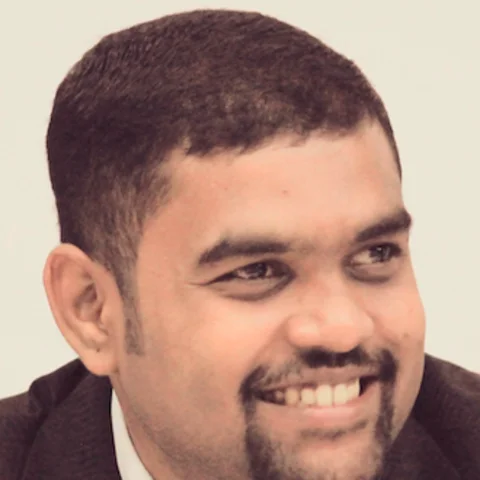
Dr. Radhakrishnan KG
Founder, WebNamaste · DBA, Swiss School of Business and Management · In SEO since 2006
SEO strategist since 2006, founder of WebNamaste (2009). Now pioneering AI visibility — helping B2B companies become the answer ChatGPT, Perplexity, and Gemini recommend.